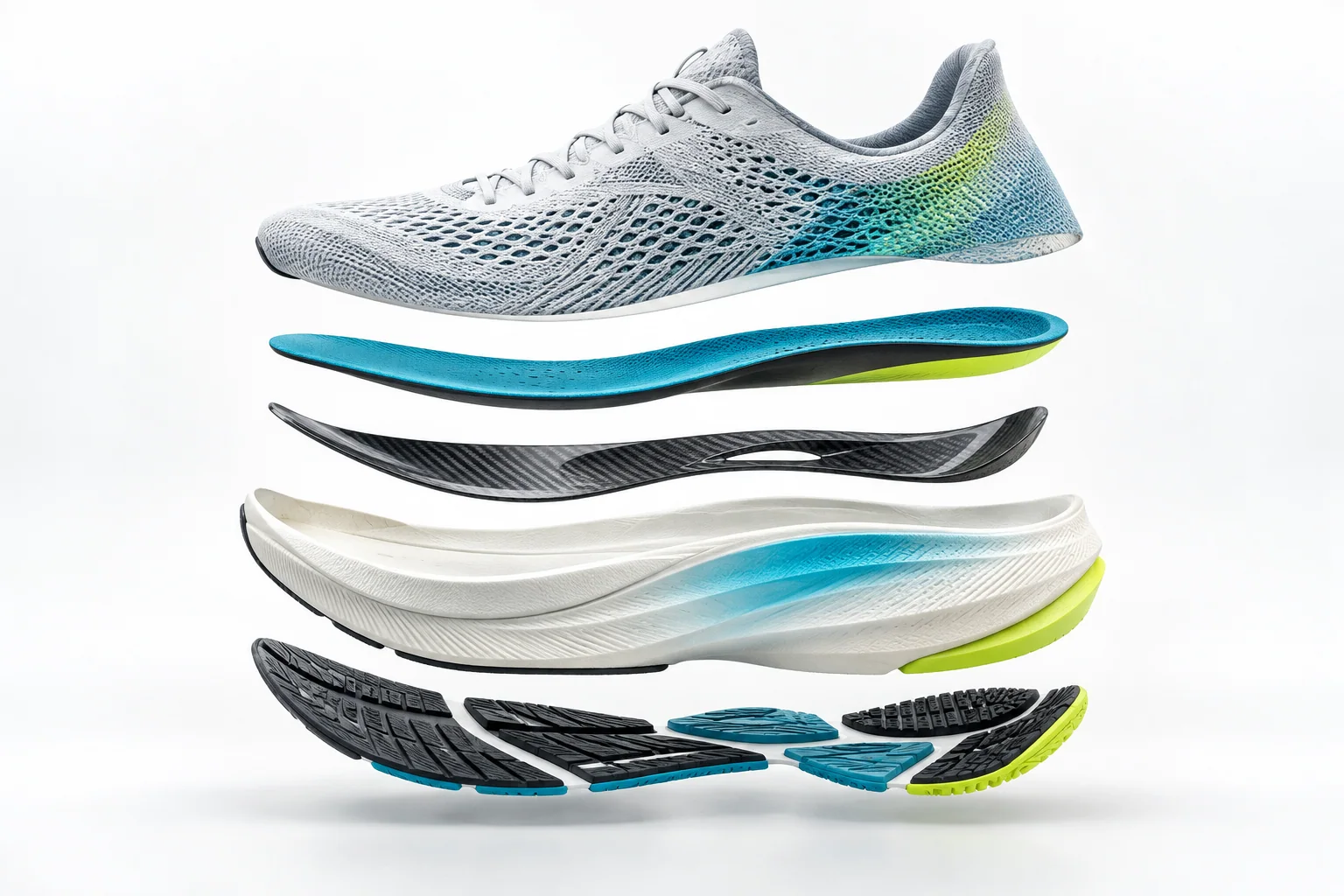
Material comparison
There is no universal best foam
Supercritical processing can create lightweight cellular structures with useful resilience, but polymer family alone does not guarantee a specific result. Supplier formulation, expansion process, part density, wall thickness, climate, runner load and repeated use all influence performance.
These are development directions, not guaranteed numerical claims. Final performance must be verified for the selected material grade and shoe construction.
SC-PEBA
Lightweight options for premium speed platforms
PEBA-class foams are frequently evaluated for race-day and fast-training concepts where low mass, compliant cushioning and responsive deformation are central to the brief. The material package must still be balanced against stability, outsole protection, bonding, temperature behavior, cost and production consistency.
For plated footwear, the development team tunes foam geometry and plate characteristics together. Plate shape, stiffness, placement and size grading should complement the rocker and runner rather than being treated as an isolated feature.
SC-TPU
Resilient cushioning for repeat use
Supercritical TPU options can suit daily training platforms where durability, mechanical resilience and reliable cushioning behavior are important. They may be considered for full-length midsoles, inserts or hybrid constructions depending on weight target and cost architecture.
Density and geometry require careful control because the same polymer family can produce substantially different ride profiles. A stable daily trainer may use sidewall shaping, broader ground contact and zoned rubber differently from a lightweight speed platform.
SC-TPEE
Dynamic response with structural support
TPEE foam options can provide a useful balance of responsive cushioning, flex performance and structure for speed trainers and performance daily shoes. The right application depends on supplier grade, processing window and the complete bottom-unit design.
Hybrid constructions may combine materials to manage cost, stability and ride character. Any interface between foam components must be designed for bonding, tolerance and long-term use.
Selection framework
Questions buyers should answer before choosing a foam
- Who is the target runner and what is the primary use case?
- What are the target shoe weight, stack, drop and base width?
- Is the brief focused on racing, training, stability or trail use?
- What temperature range and durability expectation apply?
- Will the platform use a composite plate, shank or stabilizing carrier?
- How much rubber coverage is required for the intended surface?
- Which laboratory methods and acceptance limits will be used?
- What target FOB and production volume must the platform support?
Testing and claims
Connect every performance statement to evidence
Material data sheets help screen options, but finished-shoe validation is essential. Depending on the project, the plan may evaluate density, hardness, compression behavior, rebound method, flex resistance, dimensional stability, bond strength, outsole wear and controlled use feedback.
Winmamba confirms specifications and marketing support at project level. Material availability and terminology can vary by supplier and region, so brands should avoid publishing unverified numerical claims before final test review.